↑ All Genealogy / Schmidt Line / Dudley Line / Oswald Line / Bowland Line / Seitzberg Line
Bloodline — Schmidt

The Schmidt Line

A working archive built ancestor by ancestor — tracing the Schmidt family from Otto and Henrietta's London household, across the Atlantic with Edward, and forward through his descendants in Kittery, Maine. This page grows as the research does.

Family Tree
Schmidt Line — London to Kittery, Maine SCHMIDT LINE — LONDON TO KITTERY, MAINE GENERATION I · LONDON Otto Schmidt Professor of Languages & Writer b. c. 1806 d. — · unresolved Henrietta Adonis Jourdan (Dubarle) Schmidt b. c. 1811 d. 1842 · Parsons Green m. 8 Aug 1837, St Pancras GENERATION II · SIX CHILDREN, BAPTIZED TOGETHER, ST PANCRAS 1837 Caroline Henrietta Jane Schmidt b. 1830 · London m. Thomas Turner, 1861 Adelaide Ottilia Alberta Schmidt b. 1831 · London m. Rev. W.D. Macray, 1856 PRIMARY SUBJECT Edward Alfred Henry Schmidt b. 1833 · Middlesex d. 1881 · Kittery, ME U.S. Navy · USS Sabine Eleanor Aimée Schmidt b. 1834 · London d. 1898 · Worcestershire Julia Sophia Schmidt b. 1837 · Baden m. New Orleans, 1864 Otto John Albert Schmidt b. 1839 · London d. — · unresolved GENERATION III · KITTERY, MAINE Edward Alfred Henry Schmidt b. 1833 · London d. 1881 · Kittery, ME U.S. Navy · USS Sabine Mary Catherine Dudley Schmidt b. 1840 · Boston, MA d. 1920 · Kittery, ME m. John A. Tucker, 1882 m. 28 Aug 1861, York, Maine · five children ↓ continued in Ancestor Records, below Compiled from SCHMIDTISTICS.ged & the Master Research Summary · rust-colored fields remain open questions FIG. 1 — SCHMIDT LINE, 1806–1920 SCHMIDTISTICS.COM
Ancestor Records
001
Parents of 002

Otto & Henrietta Schmidt

The Parents We're Still Searching For
Otto: Professor of Languages, London Henrietta: d. 1842, Kensington

Otto Schmidt was a professor of languages, working and writing in London in the 1830s. In August 1837 he married Henrietta Adonis Jourdan, a woman who had already lived a life of her own on the continent before coming to England. Together they raised a young family in the city — six children in all, baptized together at St. Pancras on a single day in August 1837, their birth entries all marked "Foreign Parts," a small clue to a family with roots beyond England's shore.

The marriage didn't last in any simple sense. By 1841 Otto and Henrietta were living apart, and the following year Henrietta died of consumption in Parsons Green at 34. Her death certificate, reviewed in July 2026, lists the informant as a Sarah Cook, not Otto — circumstantial support for the idea that Otto was already gone from the household by 1842, though not conclusive on its own. Otto's story trails off from there. He surfaces once more — in 1856, listed as "Professor" and, it seems, still living, on his daughter Adelaide's marriage certificate — and then vanishes from the record entirely. Decades later, his son Edward would tell a U.S. Navy surgeon that his father "died insane." That lead is now active: research converging across London Archives, the Wellcome Collection, and Hounslow Local Studies points toward Wyke House Asylum as a possible match, with Middlesex asylum admission registers next on the list.

The Children

Of the six, two crossed the Atlantic and four stayed in England — three of whom ended up bound together in Oxfordshire through a single family connection.

  • Caroline Henrietta Jane (b. 1830) — stayed in England. Married Thomas Turner, a widower from Paddington, in 1861 at Bletchingdon, Oxfordshire — the ceremony performed by her own brother-in-law, Rev. William Dunn Macray.
  • Adelaide Ottilia Alberta (b. 1831) — stayed in England. Married Rev. William Dunn Macray, a Bodleian Library scholar, in 1856 at Iffley, Oxfordshire, tying the family to Oxford for the next generation.
  • Edward Alfred Henry (b. 1833) — emigrated alone to the United States around 1851, settling in Kittery, Maine (see record 002).
  • Eleanor Aimée (b. 1834) — stayed in England. Worked as a governess in Surrey before later living with her sister Adelaide and the Macrays at Ducklington, Oxfordshire. Died 1898 at Glebe House, North Piddle, Worcestershire.
  • Julia Sophia (b. 1837) — emigrated to the United States, resurfacing in New Orleans, where she married John Henry Eggers, a fellow immigrant from Wustrow, Hanover, in June 1864. She died there in 1903.
  • Otto John Albert (b. 1839) — the youngest, and the family's last true mystery. Baptized separately at St. Pancras in September 1839, he was never definitively traced again. His absence from the 1841 census is inconclusive rather than proof of death — Julia was also missing from that same household and later turned out to be alive and well — so his fate remains genuinely open.
002
Primary Subject — Military

Edward Alfred Henry Schmidt

b. 1833, Middlesex, England d. 1881, Kittery, Maine U.S. Navy, 1858–1864

Edward was eight years old when his mother died and his family began to scatter. By sixteen he was lodging with a chemist in London; by the last days of November 1851, not yet eighteen, he had crossed the Atlantic alone and made his way to New York. Within a year he had settled in Kittery, Maine — the small shipbuilding town that would be his home for the rest of his life.

In 1858 he enlisted in the U.S. Navy. His service took him aboard the USS Sabine, where a ship's chain crushed his right hand off Pensacola and cost him a finger. He recovered, came home, and married Mary Catherine Dudley in 1861. Within months he was back at sea aboard the USS Mahaska, where an accidental discharge took a finger from his other hand. His most striking documented mission came in 1864: a covert reconnaissance into North Carolina's Dismal Swamp, scouting toward the Confederate ironclad CSS Albemarle. The mission broke him — severe sunstroke brought on a mental collapse so serious he was committed to Washington's Government Hospital for the Insane. He recovered enough to be discharged, naturalized as a citizen, and granted a modest pension. He died in Kittery in 1881, at 47, and is buried at Orchard Grove Cemetery.

Naval Service
  • USS North Carolina — enlisted Sept. 28, 1858, as Landsman (under the name Edward H. Smith)
  • USS Southern Star — 1858–1859
  • USS Sabine — 1858–1861; discharged July 12, 1861, following a hand injury off Pensacola, Florida (Feb. 26, 1861)
  • USS Mahaska — April 5 – Dec. 6, 1862; 2nd Class Fireman, re-enlisted as Edward H. Schmidt
  • USS William G. Putnam ("General Putnam") — from Jan. 24, 1863; Acting Master's Mate
  • USS Commodore Hull — Albemarle Sound, N.C., 1864; hospital ticket issued Sept. 14, 1864 following his breakdown
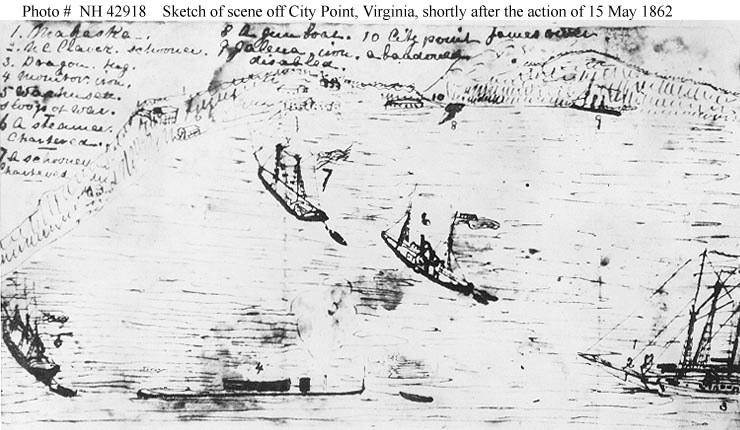
Sketch of the scene off City Point, James River, Virginia, shortly after the action of 15 May 1862, showing USS Mahaska and other vessels
Scene off City Point, James River, Virginia — shortly after the action of 15 May 1862. Sketch, possibly by Edward H. Schmidt, a crewman aboard USS Mahaska — attribution not conclusively confirmed. Received from Mrs. W.L. Smith of Savannah, Georgia, with her letter dated August 26, 1933. U.S. Naval Historical Center Photograph, NHHC Photo #NH 42918.
The Action of 15 May 1862 — Battle of Drewry's Bluff

After the Confederates scuttled the ironclad CSS Virginia and abandoned Norfolk in early May 1862, the James River lay open toward Richmond. On May 15, Commander John Rodgers led a small Union flotilla — the ironclads USS Monitor and USS Galena, the experimental ironclad USS Naugatuck, and gunboats USS Port Royal and USS Aroostook — up the river to test the Confederate defenses just seven miles from the capital. The Confederates had fortified a 90-foot bluff at a sharp bend in the river, known as Fort Darling, and sunk obstructions in the channel below it. Unable to pass, the Union ships anchored below the bluff and exchanged fire with the fort for roughly four hours. USS Galena took the worst of it, struck more than 40 times with 13–14 killed, while Monitor's turret guns couldn't elevate enough to hit the fort at such close range. Running low on ammunition, Rodgers withdrew the flotilla back downriver to City Point around 11 a.m. — a Confederate victory that kept Richmond out of reach by water for the rest of the war's early years.

The flotilla's retreat to City Point is exactly where this sketch is set. While USS Mahaska wasn't one of the five ships in the battle itself, records place her at City Point in the weeks afterward as part of the reinforcements sent to support the army — consistent with Edward being aboard to sketch the gathered fleet, including a battle-damaged Galena.

003
Marriage of 002

Schmidt & Dudley Family — Edward A.H. & Mary Catherine

Married Aug. 28, 1861, York, Maine Five children

Edward Schmidt married Mary Catherine Dudley, a York, Maine, native, in August 1861 — just weeks after his discharge from his first term of naval service and mere months before he re-enlisted for the war. Mary would spend the next two decades raising a family largely on her own while Edward served, recovered, and searched for steady footing.

The couple had five children together: Adelaide Eleanor, Otto D. (who died in infancy, named for the grandfather he never knew), Lottie H., Jennie M. (who married in Lynn, Massachusetts), and William Edward. Adelaide's own daughter carried the family's Revolutionary War lineage — through the Dudleys and Bookers of York County — into the Daughters of the American Revolution.

After Edward's death in 1881, Mary didn't stay a widow for long. On March 4, 1882, she married John A. Tucker in Portsmouth, New Hampshire, becoming Mary C. Tucker. She spent the following decades in Massachusetts — Lynn by 1900, the same town her daughter Jennie had settled in, then Malden by 1910, then Boston by 1920 — but when she died on March 13, 1920, it was back in Kittery, and she was laid to rest beside Edward after all at Orchard Grove Cemetery. A family note recalls that she was left an invalid after an accident with a runaway horse, and that she kept up a correspondence for years in the early 1900s with Margaret, William Edward's wife — a quiet thread connecting the two branches of the family long after Edward's death.

004
Son of 002 & 003 — Military

William Edward Schmidt

b. 1871, Kittery, Maine d. 1959, Encinitas, California 8th Mass. Vol. Infantry, 1898–99

Born in Kittery in 1871, William Edward was just ten years old when his father Edward died. By 1898, in his late twenties, he had made his way to Massachusetts and enlisted — three days after the U.S. declared war on Spain — as a private in Company D of the 8th Massachusetts Volunteer Infantry, a regiment raised in Lynn, the same town where his sister Jennie had settled.

His war was one of endurance rather than combat. The regiment trained through the misery of Camp Thomas in Georgia — a sprawling, disease-ridden camp of 50,000 men — and then Camp Lexington, Kentucky. The fighting ended before they ever saw action, but the regiment still shipped out, landing in Cuba in January 1899 for roughly three months of occupation duty before returning home to muster out in Boston that April — one year to the day after he'd enlisted.

By 1900 he had moved on again, this time to Washington County, Kansas, where in 1903 he married Margaret "Madge" Oswald. The couple raised their family there for over two decades before relocating, sometime between 1925 and 1930, to San Diego County, California. William Edward spent his later years working in bridge construction, and he died in Encinitas in 1959 at 87. He's buried at Fort Rosecrans National Cemetery, San Diego.

005
Marriage of 004

Schmidt & Oswald Family — William E. & Margaret "Madge"

Married Apr. 8, 1903, Washington, Kansas Seven children

William Edward Schmidt and Margaret "Madge" Oswald married on April 8, 1903, in Washington, Kansas. Madge was a local girl, born in 1883 in nearby Hanover to a father named Oswald and a mother from the Lillibridge family — a line the family is still working to trace further back.

Together they raised seven children on the Kansas plains: Lionel, Kenneth, Malcolm, Rosella, Wilber, Mancil, and Donald. Tragedy touched the family more than once — their eldest, Lionel, died in 1904 at not quite eleven years old, and decades later, after the family had resettled in California, their son Mancil died in Encinitas in 1932 at just eighteen.

The family's move west, sometime between 1925 and 1930, took them from the Kansas prairie to the growing communities of Oceanside and then Encinitas on the California coast, where William Edward and Madge would spend the rest of their lives. Madge died in December 1956; William Edward followed in March 1959. They're buried together at Fort Rosecrans National Cemetery, San Diego.

006
Grandson of 005 — Military

Richard Dean "Dick" Schmidt

Kansas Roots, a Pacific War, and a Life in Peoria
b. Dec. 3, 1925, Washington, Kansas d. Feb. 8, 2005, Peoria, Illinois USS Sumter (APA-52), U.S. Navy, 1943–1946

Kenneth Schmidt's eldest child — one of William Edward and Madge's seven children — Richard was born in Washington, Kansas, in 1925 and grew up alongside younger siblings Ronald Ray (b. 1927) and Marjorie Irene (b. 1926). By the mid-1930s the family had moved north to Wymore, Nebraska, a small railroad town near the Kansas border, where they were still living when the 1940 census was taken. Sometime in the early 1940s Richard and his mother Nellie relocated to Chicago; his WWII draft registration card lists a Chicago, Cook County address and names Nellie as his contact, suggesting his father wasn't in the household at the time.

Richard enlisted in the Navy at Chicago on October 13, 1943, and reported aboard the attack transport USS Sumter (APA-52) on July 20, 1944, as a Fireman First Class. Over the next twenty months he took part in five major Pacific amphibious operations — Palau, Lingayen Gulf, Okinawa among them — mustering aboard ten separate times as the ship carried troops to invasion beaches and back. He was promoted twice, mustering out as an Electrician's Mate Second Class the week Sumter was decommissioned in March 1946. The full ship's log, muster record, and voyage map live on the Sumter Log page.

By 1950 Richard had settled in Peoria, Illinois, where on September 17 he married Marylyn J. Seitzberg (see the Seitzberg Line), a Savanna, Illinois, native four years his junior. They raised three children — William Floyd, Janice Gayle, and Kathy Lynn Schmidt — through Peoria-area schools into the 1960s and '70s, and the couple stayed in Peoria for the rest of their lives. Richard died there on February 8, 2005, at 79; available records list cancer as the cause. Marylyn survived him by six years, passing away in Peoria in February 2011.