Kittery, September 2026
Three towns and a stretch of water
Stand on the bridge at Kittery and you can see most of it at once. York up the coast, Kittery under your feet, Portsmouth across the river, and out past the harbour mouth on a clear day, low on the horizon, the Isles of Shoals.
This family has been inside that view for well over three hundred years.
The earliest of us the documents can actually reach is Philip Adams, and we meet him only because he was already dead. On 10 December 1694 his widow sold a piece of land at York, and the deed opens by naming her:
Matthew Austin of York and Elizabeth Adams, relict and administratrix unto Phillip Adams late of York deceased…
Six pounds in current money of New England, paid by Joannah Livingstone of York. Nine generations stand between that sentence and the grandparents most of us remember, and every one of them in between has been checked.
What happened in between happened almost entirely within about fifteen miles.
The names are these. Booker and Moore and Adams at York, farming and fishing, back into the 1600s. Voudy, Varrell and Sadler out on the Isles of Shoals, where a town called Gosport sat on a bare rock nine miles at sea and this family helped run it — their births entered in the same book, on the same page, as the Muchemores and the Shapleys, and their daughters marrying Curriers and Walpeys. Ellingwood at York. Dudley at Kittery. Tucker later. And, arriving very late and from a very long way off, Schmidt.
⚠ One name that used to sit in that list has been moved out of it: Amee, at Kittery. The Amees are in this story — they are neighbours in the same deeds, and a Caty Amee married a William Dudley at Kittery in 1803 — but the register ruled on 1 September 2026 that the branch is allied by marriage, not a line of descent. No descent from the Amees has been shown, and the reason it was once thought otherwise, together with what the marriage does and does not prove, is set out in John H. Dudley.
And most of them worked on the water.
Read the old deeds and the same word keeps arriving after the men's names, the way a trade follows a surname — mariner, mariner, fisherman, seaman. William Booker, fisherman, selling land in 1760. Solomon Varrell, mariner, selling to John Voudy, mariner, in 1799. Edward Voudy, mariner, conveying to his son William Voudy, mariner, in 1803. Four Amees at Kittery in four deeds, every one of them described by what he did on the water. Boys of seventeen and eighteen on West Indies crew lists, measured and described by a customs officer in case they drowned. A Voudy who owned a quarter of a fishing schooner outright.
One of them went a very long way indeed. John H. Dudley shipped out of Portsmouth in 1829 on a sixty-eight-ton schooner bound for the Cape Verde Islands and then for South Georgia, at the edge of the Antarctic ice, and was gone two years. Half a century later his obituary did not say whose son he was. It said which ship he had been on.
Two of them went to war, eighty-eight years apart.
Aaron Booker walked out of York as a volunteer in the last days of January 1776, aged seventeen, and was standing at Dorchester when the British army evacuated Boston that March. He served twice, never received a written discharge, could not sign his own name, and swore his pension declaration from a sickbed at seventy-three because he was too ill to go to the courthouse.
Edward Alfred Henry Schmidt enlisted in the United States Navy under a false name, rose from landsman to acting master's mate, and in June 1864 volunteered to take a party into Confederate-held territory across a corner of the Dismal Swamp to find out where a rebel ironclad was. He came back with the information and with the illness that ended his career.
And then there are the Schmidts, who do not fit the pattern at all.
Everybody else in this story stayed put for three centuries. The Schmidts crossed the world in three generations.
Prussia → London → Kittery → California
Otto Schmidt was a Prussian schoolmaster in London — "I am not a native of this country, but a Prussian," he wrote of himself in 1842 — who taught languages, published grammars in Berlin and London, and had ten children in twelve years, of whom five were living when he wrote it down.
His son Edward left London alone at eighteen, sailed for New York, went into the American navy, and married Mary Catherine Dudley at York in 1861 — the moment the wandering line and the rooted one meet. Everything on this page above that marriage is hers. Everything above it on his side is in another country.
And Edward's youngest son, William Edward Schmidt, born at Kittery in 1871, went west again — Maine, then Washington, then Kansas, then San Diego, where he died in 1959.
Three hundred years within fifteen miles, and then one family crossing an ocean and a continent inside a hundred.
Where this came from
It started with Great-Grandpa Schmidt.
K.O. Schmidt left the family a set of handwritten notes — names, dates, and the stories he had been told. Some of it was solid. Some of it was family legend, in the way that every family has legend. All of it was a beginning, and about fifteen years ago it became the reason somebody started pulling at the threads.
What grew out of those notes was years of looking: burying grounds and town clerks' offices, registries of deeds, libraries and archives, worked into travels that kept finding one more question behind the last one.
What is on these pages is the stage after that, and it is a different kind of thing. Every date, name and quotation either traces to a document somebody has actually opened and read — a deed, a ship's book, a probate file, a church register — or says on the page that we do not have the document yet. Where something rests on the notes, on a family tree, or on somebody's recollection, the page tells you so and names it as such. Each piece ends with the list of what it rests on, so you can go and look yourself.
Where we do not know something, the pages say so. That includes the two places where the chain of descent is still an inference rather than a proof, and the several places where a date everybody repeats turns out to have no record behind it at all. That is not a weakness in the research. It is the research.
⚑ And none of it takes anything away from the notes. Somebody has to write the first version before anyone can check it — has to care enough to sit down and put the names on paper while he still remembered them. K.O. Schmidt wrote the first version. Everything here is the checking.
A few words you will meet
These pages quote clerks, and clerks wrote in their own shorthand. Nothing here is complicated once it is said plainly.
- Deed — the legal record of land changing hands. Read in order, a run of them is a family's fortunes written down by somebody who did not care about the family.
- Grantor / grantee — the person selling and the person buying. A grantee signs nothing, which is why some of our ancestors have no surviving signature.
- Mortgage — land put up as security for a loan. If it is never paid off, the land goes. That happened to the Bookers.
- Intention · publishment · banns — three words for the same thing: a marriage was announced in the town book and read out, so anyone with an objection could raise it. An entry is not a wedding. Most are followed by one. Some are not.
- Certificate — issued by the clerk after the announcement had run its course. Then you could marry.
- Probate — the court process after a death. Testate means there was a will; intestate means there was not.
- Administration — what the court grants when there is no will, appointing someone to settle the estate. An administratrix is a woman doing it, and in this family that is often a widow.
- Inventory and appraisal — a list of everything the dead person owned, valued by neighbours the court trusted. It is the closest thing we have to walking through their house.
- Dower — a widow's legal right to part of her husband's land for her lifetime. You will see her "releasing dower" in deeds, which means signing so the buyer gets clear title.
- Life estate — giving property away now while keeping the use of it until you die. Two men in this family did exactly that, a generation apart.
- Mariner · coaster · yeoman — how a man's occupation was written down: a deep-water sailor, a man working the coastal trade, a farmer working his own land.
- Crew list — the form a customs officer filled in before a voyage: every man's name, age, birthplace, height, complexion and hair colour, in case he deserted or drowned. For most of the men here it is the only physical description that survives.
- Relict — an older word for widow.
⚑ And one habit of our own: where a page says a record was read at the image, it means somebody opened the original page and read it — not an index, not a transcription, not somebody else's family tree.
Everything below is drawn from the documents themselves and written to be read straight through. The evidence sits in a short section at the end of each piece, so you can check anything without it interrupting the story.
Portraits — one ancestor, one page
Aaron Booker
His father died when he was five and his mother took the administration herself. He was at Dorchester at seventeen when the British left Boston, farmed the same nine acres for fifty years and mortgaged them twice, could not write his name, and did not know how old he was.
William Voudy
Born into a hole in the record after the Isles of Shoals were evacuated, and gone out of it again the same way. His mother and father signed by mark; he signed his name — and wrote three generations of this family into a public deed.
Edward Alfred Henry Schmidt
He enlisted in 1858 as Edward H. Smith, born — he said — in Connecticut. He came ashore in 1861, bought a house, married, and walked back into the war under his own name. The Treasury certified both enlistments as one man's.
John H. Dudley
One date, one ship and one sentence. The only record of his birthday is a watch list written at sea; he owned no land, left no probate, and has no marriage record in three states — and that absence turns out to be the most precise description of him we have.
Lydia Jane Dudley
She bought a York house in her own name in 1855, sold it in 1864 and carried half the price herself, paid a thousand dollars for a Kittery acre as a married woman in 1873, and still owned land on a Lynn street at sixty-seven. Her husband is not in the county deed record at all — and she is the reason why.
Solomon Varrell
Baptised on a rock nine miles out to sea, rated at New Castle at twenty-two, married at York in an entry the clerk later erased, and dead in 1819 leaving a schedule of money other people owed him. Seventeen documents, every one read at the image.
Dorcas Voudy
No birth record, no death record, no notice in print, and a surname that reaches us written above a line in 1803. Everything this family knows about its Maine ancestry passes through her, and she left less paper than anyone else in the archive.
Stories — the family together
Bound for Martinique
Two hundred years at sea, and how it reaches us: the Isles of Shoals, the word after the name in the deeds, an impressment at Antigua, a boy of four foot eight bound for Martinique, a sealing voyage to South Georgia — and the marriage that ties them all together.
How Long We Have Been Here
Nine miles out to sea, a town called Gosport on a bare rock — where three Muchemores and a Voudy ran the meeting, the town's money was fish, and this family kept its own books because nobody on the mainland would. Then everyone in it walked out of the record.
Edward and Mary
She was twenty-one when she married him and seventy-nine when she died. A war, five children, a house burned by a defective chimney, a widowhood at forty-one, a pension refused at seventy-one — and a daughter who came back from Missouri to be in the room.
Otto to William Edward
“I am not a native of this country, but a Prussian.” A London schoolmaster who counted ten children in twelve years and five alive, wrote to a charity three weeks before his wife died — and then vanished out of the record entirely.
The Booker Ground
Grant, homestead, auction, absence, nine acres, mortgage — and then somebody else's name on it forever. A hundred and twenty years of one family's land at York, and the 1848 deed that proves the mortgage was never redeemed.
Forbidden by the Bride
Two York women stopped their own weddings and had it minuted — “Forbiden by Elizabeth Averil,” “Forbidden by Lucy Tinnum.” One of them married a Booker five years later. And between them they proved the archive had been misreading its own evidence.
The Road to the Nursery
Seven deeds, one acre that changed hands twice in a single day at no profit, a deed signed on a New York wharf, and three men called John Lewis who turned out to be one. At the end of it: the man Rogers Road is named for, and why the family's Kittery land was never in John Dudley's name.
The Women Who Held the Paper
The earliest person this archive can reach is a widow selling her husband's land in 1694 — and it turns out to be the pattern. Eight women on the operative documents across nearly two hundred years, because the men were at sea and somebody had to sign.
Nineteen Years of Banns
Between 1818 and 1837 Lucy Booker's name went into the marriage intention books of two towns nine times, against six different men — and the clerk's own word proves she was still unmarried at the end of it. She married the sixth.
The ground itself
Four maps, so you can find the places before you stand in them. Click any of them to open it full size and zoom in.
Kittery
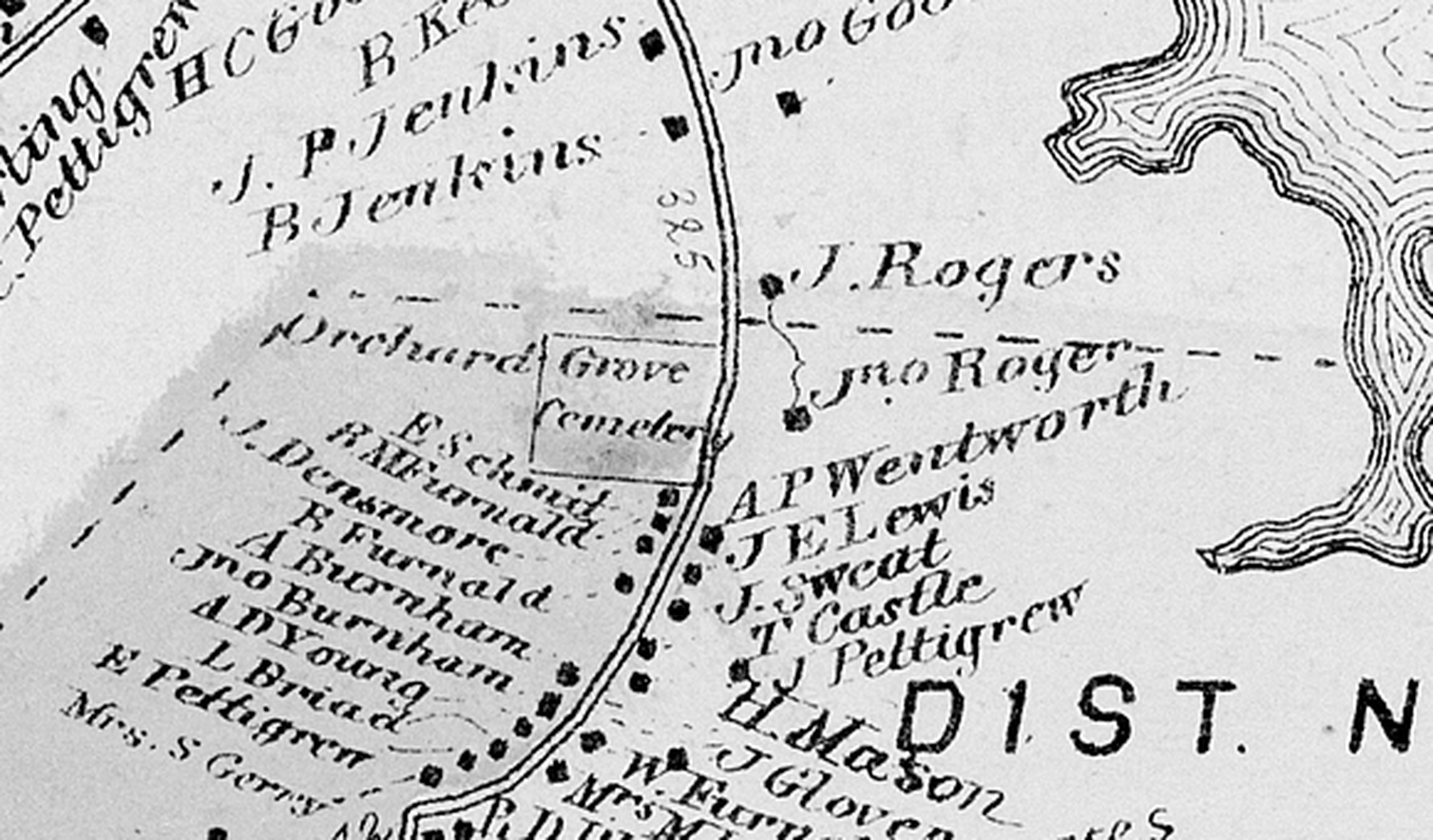
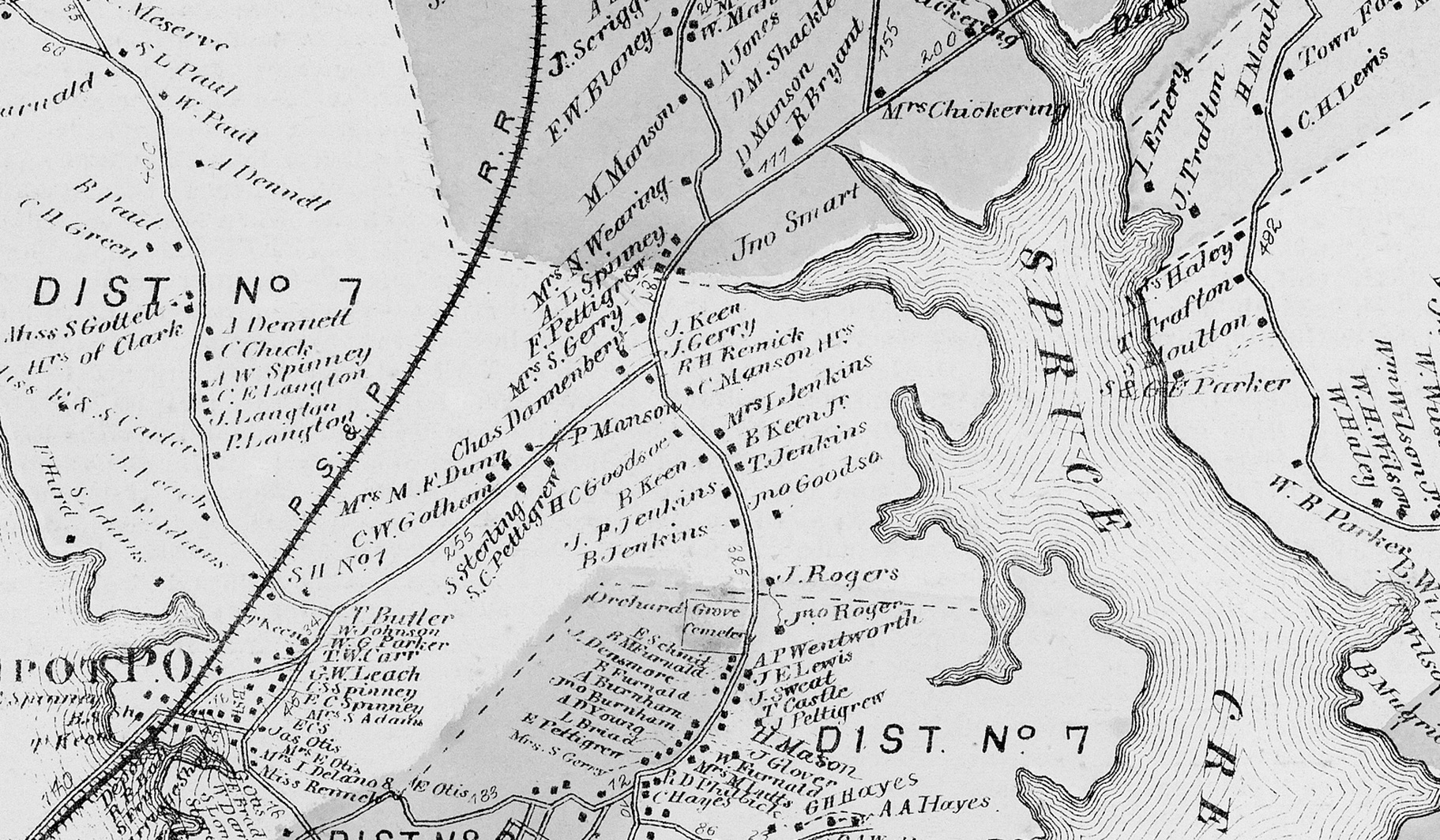
York
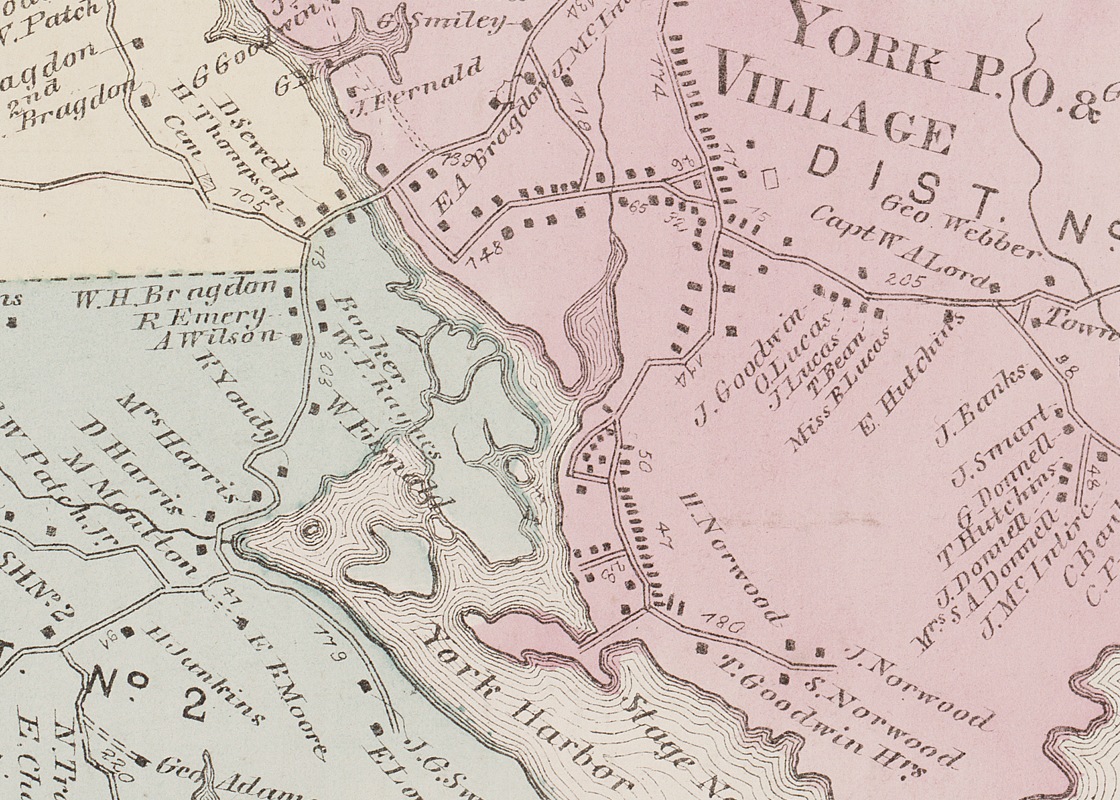
build_reunion.py · do not edit this file —
edit the Markdown and re-run md2html.py