The Booker Ground
A hundred and twenty years of one family's land at York, told as what happened rather than as a chain of title
What this is. The land itself — nine acres at York held by the Bookers, the family Dorcas Booker came from, and therefore the ground the Voudy and Dudley lines grew out of. Grant, homestead, mortgage, and then somebody else's name on it for good.
A deed is simply the legal record of land changing hands. Read in order, a run of them is a family's fortunes written down by a clerk who did not care about the family.
A deed is a boring document that records an interesting day. Somebody needed money, or died, or wanted to keep a farm in the family. The clerk wrote down the boundaries and the price and none of the reasons.
Put the Booker deeds in order, though, and the reasons start to show — because you can watch a family acquire ground, lose it at auction, and end up a century later holding nine acres by a creek that pass out of their name altogether.
It starts with a grant, not a purchase
John Booker was an original grantee of the Proprietors of York.
That is not a small thing. The proprietors were the men who held the town's undivided common land and parcelled it out; an original grantee held a share, and a share was heritable property. We know it because in the middle of the eighteenth century a York gentleman named Samuel Bragdon sold five shares in the tract "called Number One in the First Division of the Stated Common" and had to recite where they came from:
…which were originally granted by the Proprietors of York aforesaid to JOHN BOOKER, of whom I purchased the same.
He also held ground on the far side of town. A deed of gift from Christopher Cottle the elder to his son, executed on 1 August 1765, runs its boundary "South East as Kittery & York line runs till it comes to a rock maple tree spotted, standing at the corner of the land of John Booker's land, standing on the line between said York & Kittery."
A spotted maple on a town line, with a Booker on the other side of it.
1761: a father, a son, and twenty pounds
On 15 October 1761 John Booker acknowledged a deed at York — but he was no longer living there.
Know ye, that I John Booker, late of York, now of Boston in the County of Suffolk and Province of the Massachusetts Bay, for and in consideration of the sum of twenty pounds four shillings and ninepence lawful money… paid by my son William Booker of the same York aforesaid, labourer…
It is a mortgage of part of his homestead, and it does something no other document in this family does: it states the father-and-son joint in the grantor's own words. William Booker is Aaron Booker's father. John Booker is therefore Aaron's grandfather, and that is documented rather than guessed.
Note the two facts sitting quietly in the same sentence. The father had left York for Boston. The son was a labourer.
And then William started buying
On the very next page of the same record book, in November 1761, William Booker bought again — from Diamond Sargent, tailor, and Joseph Sargent, mariner, both of York, for twenty-six pounds thirteen shillings and fourpence. He is styled fisherman.
Not long after he bought a second parcel out of the estate of Abel Whitney, and in that one the clerk styles him yeoman.
Two acquisitions on consecutive frames, and a change of description from fisherman to yeoman. He had sold land before — a quarter of a large tract to Samuel Sewall in July 1747, and, in December 1760, the whole of the island “on which I now dwell” off the mouth of York Harbour — about eight acres of land and marsh with the buildings, “being the same Island I purchased of Sir W.m Pepperrell on the 9th of July 1747” — to an Abraham of Ipswich, housewright, for sixty-six pounds thirteen shillings and fourpence, his wife Dorcas signing that one by mark. ⚠ His surname is read as Pilton by the Registry's imaging system and as Tilton by FamilySearch, and a later deed has the man reciting his own name as Abraham Tilton; it has never been read on a master and is not settled here.
He was assembling land in the last two years of his life, and he did not have long. William Booker died on 23 September 1763, intestate, leaving nine children. His widow Dorcas was bonded to administer the estate, with her own father Samuel Moor standing surety.
1765: the homestead is auctioned
The family's oldest ground went at public auction, and the sale was ordered from Boston.
On 4 July 1765, by virtue of an order of the Superior Court of Judicature sitting at Boston, Anne Booker of Boston, widow and administratrix of the estate of John Booker, conveyed to Joseph Simpson Junior of York — "being the highest bidder, as the same was sold by way of public vendue after due notice given" — for forty-two pounds:
the whole of the said deceased's real estate situate in York aforesaid, being part of the lands on which he formerly lived on the south west side of York River, formerly called his homestead, and is all the remaining part of the same which he did not dispose of in his lifetime.
Read that clause slowly. All the remaining part of the same which he did not dispose of in his lifetime. The homestead on the south-west side of York River went out of the family in one afternoon, to the man who bid most — two years after William died and four years after John had mortgaged a piece of it to his own son.
Aaron Booker was six years old.
Two generations with nothing recorded
Between 1765 and 1817 this family holds no land that this project has found. Aaron grew up, went to Cambridge and Dorchester as a soldier at seventeen, came home, married Anne Ellingwood in February 1779, and farmed.
When the record picks him up again he owns nine acres, and he is mortgaging every inch of them.
1817: the nine acres
On 17 November 1817 Aaron Booker of York, yeoman, conveyed to William Voudy of York, mariner — who had married Dorcas Booker at York in 1803 —
⚑ A word used throughout this piece, and what stands behind it. No document states that Dorcas was Aaron's daughter. It is the strongest inference this archive holds — the land, the dealing between the two men, and an age check on the Booker women of that generation — and it is set out in full at the foot of the page. Where son-in-law appears below, it is that inference in one word, not a second claim.
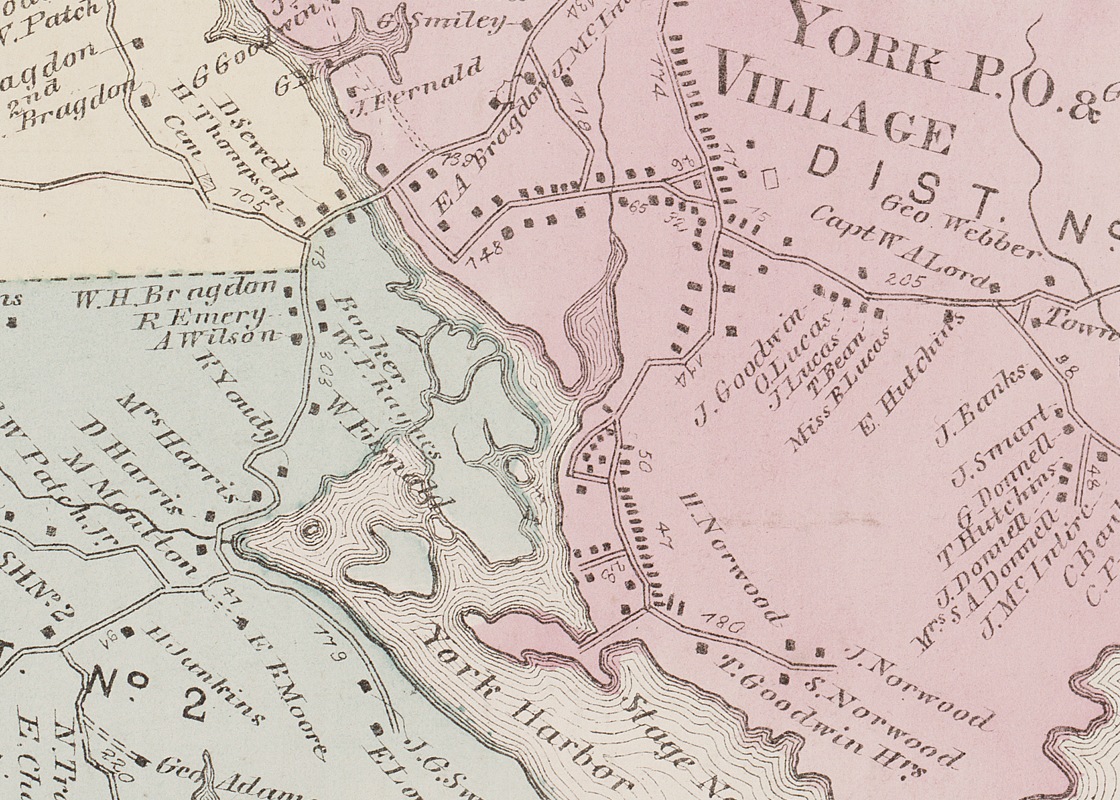
all my farm in York, containing nine acres, more or less, with the buildings thereon standing, lying on the south side of York River, bounded on the north east sides by lands belonging to heirs of Josiah Weeks, deceased, and on the highway on the north westerly and south westerly sides, and on the cove or creek separating Harmon's Island from the main land on the south east.
The consideration was forty-three dollars and thirteen cents, with five years to repay the note. He signed it Aaron ✗ Booker.
Set that against what land actually cost. Five years earlier another York man had paid seventy dollars for a single acre at Sewall's Bridge. Aaron put nine acres and a house behind a note for less than two-thirds of one acre's market price.
And two years later he did it again — on 20 December 1819, mortgaging to William Booker of Portsmouth, chaise maker. Whether it was rescue or need, the deeds do not say.
The nine acres never came back
Here is the quiet ending, and it took a deed of 1868 to prove it.
In April 1848 — in a deed that was not put on record until September 1868 — William Voudy conveyed those same nine acres to his son Reuben for two hundred dollars — reserving to himself "and to my wife Dorcas Voudy during my life and her life" the complete possession and profits of the place, "the same as if this deed had not been made."
Both instruments describe the land in words lifted straight out of 1817 — the heirs of Josiah Weeks, the highway, the cove that separates Harmon's Island from the mainland — and both call it:
the same that was formerly owned by AARON BOOKER dec.d
⭐ That settles what happened to the mortgage. It was never redeemed. Aaron never paid off the forty-three dollars and thirteen cents, the land stayed with his son-in-law, and it passed to a Voudy grandson. It is also why Aaron Booker left no estate to probate. He had nothing left to leave — he had already conveyed it, and by 1840 he was living in that same house as a lodger in his son-in-law's household, aged eighty-nine on a printed federal list of pensioners.
⭐⭐ And that 1848 deed is the single most important document this family owns, for a reason that has nothing to do with land. It is the only instrument anywhere that names Aaron Booker and Dorcas Voudy in the same breath — a woman holding a life estate in the farm of the man we believe was her father. It still does not say so. But of all the paper this project has read, that is the sheet that comes closest.
The other Booker, and the half a house
Running alongside all this is Abraham Booker of York, mariner, whose relationship to the rest is still unknown — and whose deeds are the sharpest short story in the whole collection.
September 1812: he buys an acre at the easterly end of Sewall's Bridge for seventy dollars.
May 1815: Jacob Cutter of Portsmouth, merchant, takes him to court and wins forty-three dollars and thirty-two cents damage plus eleven dollars and eighty-one cents costs. The writ carries a capias — the sheriff is commanded to "take the body of the said Booker and commit unto our gaol in York or Alfred… until he pay the full sums." The officers come instead and levy on the property: one acre, and the north-easterly half of the house, divided from the middle of the chimney. The return notes, in the flat language of an execution, "the said Abraham Booker refusing to choose any person" — a man declining to name one of the three appraisers who would value his own home.
May 1852: at nearly seventy, still styled mariner, he sells a house lot near Sewall's Bridge for a hundred and fifty dollars — and signs his own name, where Aaron Booker a generation earlier had made a cross.
April 1862: his son Alvin sells property and recites his title: half "descended to me as heir at law of the said Abraham Booker, my father" and half bought from "my sister, Elizabeth."
What the ground says
Grant. Homestead. Auction. Absence. Nine acres. Mortgage. Mortgage again. And then somebody else's name on it forever.
A hundred and twenty years, and the shape is not a rise. A man who was given land by the proprietors of a town ends with a great-grandson who could not write his name mortgaging his whole farm to his son-in-law for forty-three dollars, and dying in that son-in-law's house.
That is not a failure of anybody in it. It is what happened to a great many coastal Maine families between the proprietors' divisions and the Civil War, and the reason we can see it happen to this one is that every step of it had to be written down and recorded in a book.
How we know this
- John Booker as an original grantee — the Bragdon-to-Grow recital and the proprietors' share list. V-256.
- The Booker land on the York/Kittery line — the Cottle deed of gift, 1 August 1765, read at the image. D-148.
- Father to son, 15 October 1761 — read at the image at magnification on a downloaded master. V-257.
- William Booker's purchases — the Sargents, November 1761, on the very next frame; and the Whitney estate parcel. V-259.
- His earlier sales — to Samuel Sewall, 11 July 1747; and, 4 December 1760, the island “on which I now dwell” off the mouth of York Harbour, eight acres with the buildings, for sixty-six pounds thirteen shillings and fourpence, to an Abraham of Ipswich whose surname is not settled. ⚠ The Registry's own imaging system reads Pilton; the FamilySearch transcript of the same leaf reads Tilton, and a later York deed has the man himself reciting “I the said ABRAHAM TILTON purchased of William Booker late of York aforesaid dec.d”. Two instruments against one, and the surname has never been read on a master — so it is left open here rather than guessed. ⭐ What is settled is the signature block, read at the master: “DORCAS [her mark] BOOKER (Seal)”, with the word mark written above it, beside “William Booker (Seal)”. D-98, D-24.
- His death and the administration — York County probate file 1356, the bond of 23 September 1763 with Samuel Moor surety, and the letters reciting intestacy. PR-WMBOOKER, PR-WMBOOKER2, PR-WMBOOKER3.
- The auction of 1765 — Anne Booker, administratrix, to Joseph Simpson Junior, forty-two pounds, at public vendue under an order of the Superior Court of Judicature at Boston. V-260.
- Aaron Booker's mortgage of 1817, read at the image including the mark and both witnesses; and the seventy-dollar acre for comparison. D-146, D-102, D-100, D-08, D-143.
- The second mortgage, 20 December 1819. D-103.
- The nine acres to Reuben Voudy — one deed, not two: executed and acknowledged 11 April 1848 and not recorded until 5 September 1868, reserving a life estate to William “and to my wife DORCAS VOUDY during my life and her life” and reciting the farm as “the same that was formerly owned by AARON BOOKER DEC’D”. ⭐ The reservation names her, so Dorcas was living on 11 April 1848. ⛔ The 1868 date is the Register of Deeds’ receipt only. D-29.
- Aaron in his son-in-law's household, 1 June 1840, from the printed federal pensioner census. V-54.
- Abraham Booker's papers — the purchase of 1812, the execution, capias and levy of 1815, the sale of 1852, and his son Alvin's recital of 1862. D-143, D-151, D-152, D-141, D-142.
- Aaron's own life — birth, service, marriage and death — is on his own page, from B-26, B-25, V-292, B-29, P-05 and B-30.
What is not established
- Dorcas Booker as Aaron Booker's daughter. No document states it. The 1848 deed puts Aaron's former farm and Dorcas's life estate in one sentence and is the strongest evidence there is, and it still stops short. The whole Booker, Moore and Ellingwood ancestry hangs from this one inference.
- John Booker's death. Anne Booker is his widow and administratrix by 1765, and the court order authorising the sale is dated August 1763, but no death record has been read.
- Anne Booker herself — John's widow, of Boston — is otherwise unknown to this project.
- What became of the family's land between 1765 and 1817. Fifty-two years, two generations, and no Booker deed found.
- Abraham Booker's place in the family. He was born about 1783 in the same small town as Dorcas Booker and nothing connects them. He must also not be merged with the Abraham Booker born in 1742.
- Whether the York/Kittery-line parcel and the York River homestead are the same John Booker's. The name is the same and the town is the same; the ground is miles apart.
D-24, PR-WMBOOKER, D-146, D-08, D-103, D-29, V-54, D-142, B-26, B-25, B-30.05-booker-deeds.md · do not edit this file —
edit the Markdown and re-run md2html.py